
Customer story
Po Hlyan
Po Hlyan Food & Beverage
A bilingual storefront for Myanmar's first fried green chili paste, built around product trust, serving education, guest ordering, COD, and Telegram owner notification.
Overview
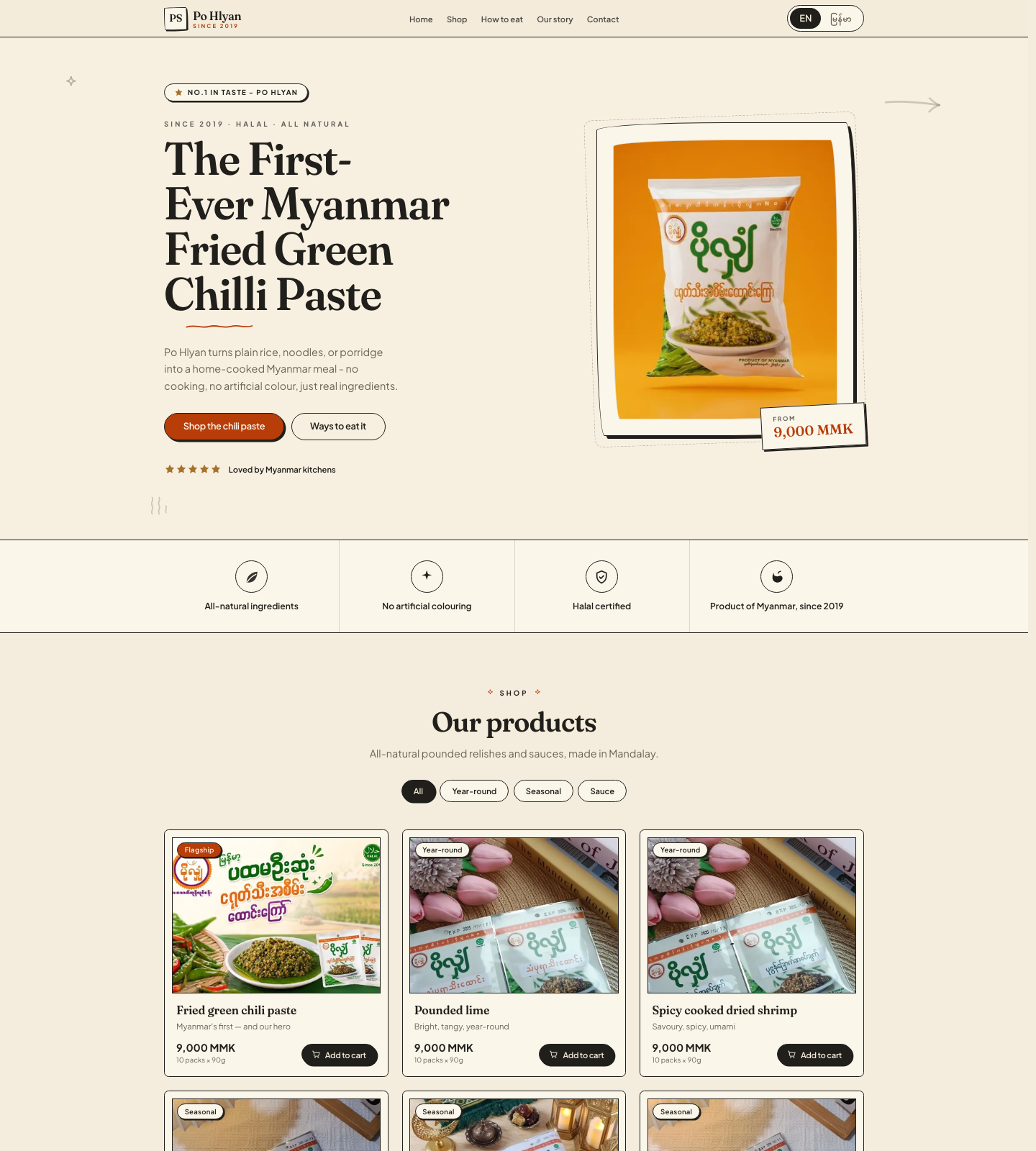
Po Hlyan needed a storefront that could sell food and explain the brand at the same time. The business is known for Myanmar's first fried green chili paste, supported by a wider catalog of traditional pounded relishes and sauces. The website had to make the product feel authentic, convenient, safe, and easy to order for customers in Myanmar and overseas Myanmar communities.
The project was designed around a simple business truth: food customers do not only buy a product name. They need appetite, trust, serving ideas, delivery clarity, and a low-friction way to order. The website had to carry those jobs before the owner entered the conversation.
Operating Context
Po Hlyan sells a product category that benefits from explanation. Customers may want to know how spicy it is, what food it pairs with, how delivery works, and whether ordering from the site is safe. The owner also needed the workflow to stay close to the existing operation: guest order submission, Telegram notification, delivery coordination, and cash on delivery.
The site therefore acts as both storefront and sales assistant. It introduces the brand, educates the customer, supports product selection, and turns intent into an actionable order notification.
Challenge
The challenge was not only visual design. Customers need to understand what the product is, how to eat it, why it is trustworthy, and how to order without creating an account. The owner also needed to preserve the existing workflow: customers order, the owner receives the order through Telegram, delivery is arranged manually, and payment is collected through cash on delivery.
For a food product, generic ecommerce design can feel cold. The interface needed to feel local, handmade, and credible without making the order path confusing. It also had to support bilingual content so both English and Myanmar readers could understand the offer.
Design Direction
We chose a warm ink-on-paper direction rather than a generic grocery interface. The design uses a handmade editorial feeling, product photography, hand-drawn line frames, warm paper surfaces, and rare orange accents. This makes the brand feel local, appetizing, and trustworthy while keeping the page clear enough for product browsing and checkout.
The visual system treats the product as a signature item, not a commodity. The brand mark, textured framing, product photography, and serving-focused copy work together to make the food feel familiar and worth trying.
Plan
The storefront is a prerendered React/Vite site. It includes bilingual EN/MY content, catalog sections for year-round and seasonal products, product detail support, serving ideas, customer reviews, guest cart and checkout, external order API integration, Telegram order notification, Cloudflare Web Analytics, Facebook Pixel readiness, sitemap, structured data, and hreflang.
The planned customer path moves from brand trust to appetite to order: understand the hero product, browse supporting products, learn how to serve it, add items as a guest, submit the order, and let the owner continue fulfillment through the workflow already used by the business.
Design Decisions
1. Make trust visible before checkout
The site explains the product, origin, use cases, and customer reassurance before asking for an order. This matters because food purchases require confidence in quality, taste, and delivery.
2. Preserve guest ordering
Requiring accounts would add friction for a small food business. Guest ordering keeps the path direct while still collecting enough information for fulfillment.
3. Send operational events to Telegram
Telegram notification keeps the website connected to the owner's real operating rhythm. The site can accept orders, but the owner still receives them in a channel that supports fast manual follow-up.
Problem Solved
The final direction gives customers a clear path from brand trust to product understanding to order submission. The owner gets a website that supports sales without forcing a new operational system. Orders can still move through Telegram, delivery arrangement, and COD while the storefront does the product education and conversion work.
Live View
Live site: https://pohlyan.billionsplus.com